

Baku’s backing for Ukraine is less about confronting Russia than about quietly broadening the mix of partners it relies on.
38 Women and Children Killed in Iran Over Two Months
Tabriz Activist Mehrdad Qadiri Arrested
Iran’s Oil Reserves Stored on Tankers Run Dry Amid US Blockade – WSJ
Trump Says US Will Reach an Outcome on Iran “One Way or the Other” Soon
Al-Akhbar: US issues final warning to Iran over strikes on nuclear facilities
Arabian Gulf oil exports exceed prewar levels despite Iranian attacks — WSJ
Renewed US-Israeli attacks on Iran remain possible, FT reports
Two Lawyers Arrested in Tabriz
Amnesty International Raises Alarm Over Executions in Iran
Anti-Azerbaijan Protest Held in Tehran
Political Prisoner Dies in Karaj Prison
Iran Arrests 39 People Over January Protests
Israel’s Foreign Minister Accuses Iran of Hypocrisy Over Comments on France’s Protest Crackdown
US Attack on Iran Possible, Araghchi Warns
Vance Says He and Trump Share the Same Approach to Military Action Against Iran
IRGC Helping Direct Houthi Attacks, Media Reports
Saudi Arabia Accuses Iran of Fueling Increased Houthi Attacks
Another Cleric Killed in Iran
Kurdish Party Reasserts Territorial Claims Against Azerbaijan
Anti-Azerbaijan Protest Held in Mashhad
Israeli President: Azerbaijan is a very tolerant country, Baku taking important steps for international peace under such circumstances
US Weighs Deploying ‘Mother of All Bombs’ in Potential Strikes on Iran – CNN
Islamic Republic Could Fall Under These Circumstances – Ardestani
Women’s Basij Unit Commander Killed in Shooting in Sistan and Baluchestan
Iranian Police Shoot and Kill Three Civilians
Four More Prisoners Executed in Three Iranian Cities
Qatar’s Emir Accuses Iran of Violating the Country’s Sovereignty
Lake Urmia’s ecological balance remains unrestored, official says
WSJ: Iran threatens to deploy troops into neighboring countries as it prepares for renewed war
Chinese Foreign Minister Wang Yi to Visit Azerbaijan
Israeli President Isaac Herzog to Visit Azerbaijan
Hundreds of armed fighters sent into Iran, state-linked media reports
Iran’s Supreme Court Upholds Death Sentence of Another Political Prisoner
Armed Clashes in Iran Leave Dead
Isfahan Judiciary Chief Threatens Women Who Do Not Wear Hijab
Ideological Centers in Iran Call for Provocations in Azerbaijan
Mirsalim: Iran’s Oil Belongs to God and the Prophet
US Report: Iran’s IRGC Recruits Children as Young as 12 for Security Missions
Iran sentences another protester to death
Three-day strike plan against Iran presented to Trump
Police Major Shot Dead in Iran’s Sistan and Baluchestan Province
Police arrest 16 people in operation across Tabriz
Iran targets Kurdish bases in northern Iraq
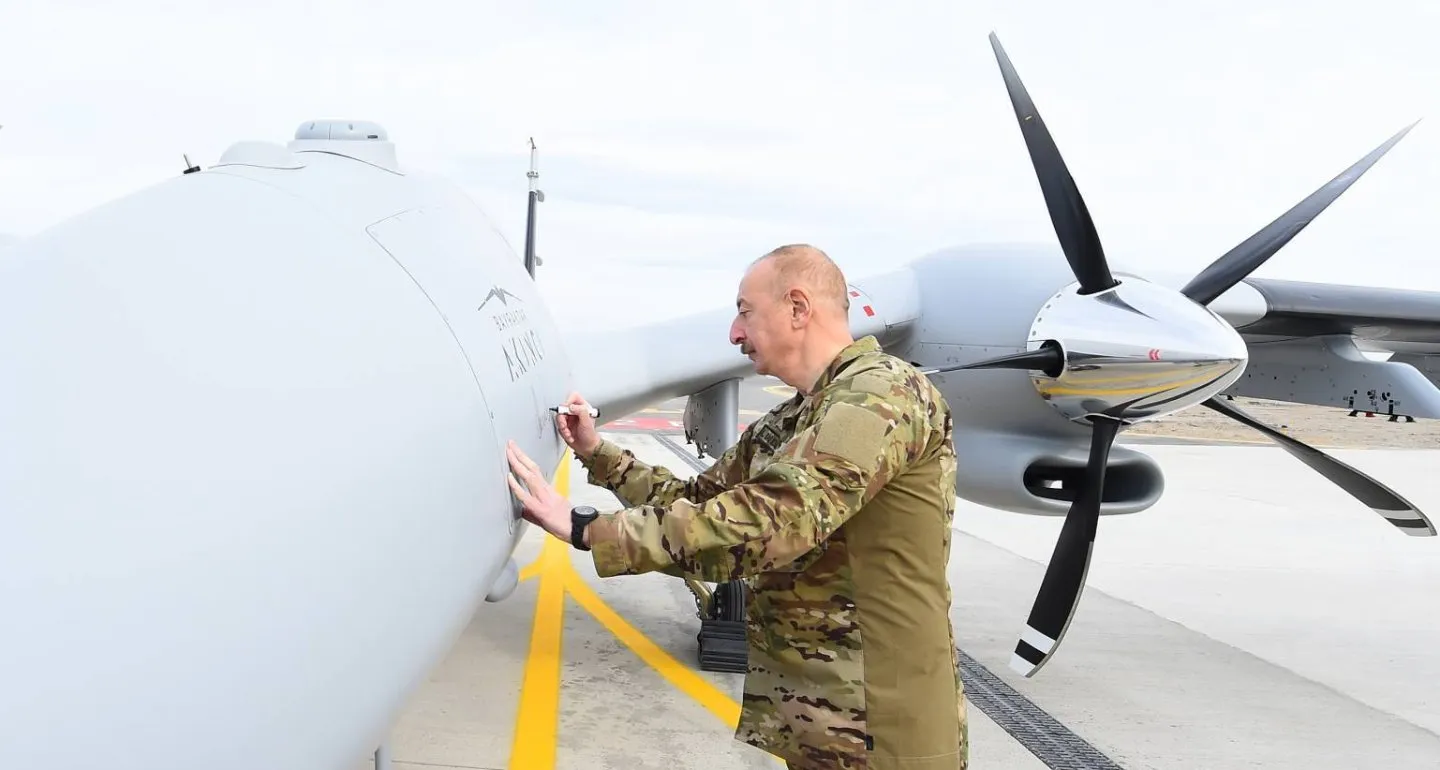
Baku’s backing for Ukraine is less about confronting Russia than about quietly broadening the mix of partners it relies on.
By Zaur Shiriyev, nonresident scholar at the Carnegie Russia Eurasia Center.
Since Russia’s full-scale invasion of Ukraine in 2022, third countries’ policies toward Kyiv have often been read in binary terms: either as a break with Moscow or as evidence of continued alignment. Azerbaijan is no exception. If Baku helps Kyiv, it is seen as drifting away from Russia; if it acts cautiously, its support is treated as limited. This says more about external expectations than about Azerbaijan’s actual priorities.
Ukrainian President Volodymyr Zelensky’s visit to Azerbaijan in April illustrates the limits of that framing. The most visible element was his remark that Baku could host future talks with Russia: an idea the Kremlin quickly dismissed. But the trip was not primarily about finding a place for talks. Ukraine and Azerbaijan signed six agreements, and Zelensky made clear that defense-industrial cooperation was the main focus, with energy close behind. The documents themselves have not been published, so public debate has centered on these broad themes rather than on the details of any single deal.
The April meeting was not a one-off. Zelensky and his Azerbaijani counterpart Ilham Aliyev have met or spoken several times since 2022. Azerbaijan has publicly backed Ukraine’s territorial integrity and, since Russia’s full-scale invasion in 2022, provided more than $45 million in humanitarian and energy aid, including generators and other equipment supplied after Russian strikes, while the State Oil Company of the Azerbaijan Republic (SOCAR) provided free fuel to ambulances early in the war. For a long time, this was largely the extent of cooperation, but that is now starting to change on the defense industry side.
One reason is that for years, the unresolved Karabakh conflict between Azerbaijan and Armenia made many countries cautious about selling weapons to Baku or speaking openly about defense cooperation and procurement, including Ukraine. In the 1990s, Kyiv was one of Baku’s main arms suppliers, but Azerbaijan later turned to other states for more advanced systems. The draft text of a peace agreement that Armenia and Azerbaijan initialed in Washington in August 2025 reduced some of those constraints and made it easier to return to defense industry cooperation with a Ukraine that now offers cutting-edge wartime experience rather than legacy stock.
In 2024, new laws and licensing rules in Azerbaijan allowed private companies to enter the defense sector. Officials say the country already sells some military products and would like exports to reach about $1 billion a year within the next three to four years. This year, Baku has signed a string of defense and joint production agreements with partners from the Gulf, Europe, and the wider post-Soviet space, underlining that it wants to be seen as a producer and not only a buyer.
This shift also suggests a change in Azerbaijan’s threat perception, with less emphasis on the likelihood of renewed large-scale war with Armenia. The initialing of the peace agreement, which has yet to be signed, has at least lowered that risk and opened a narrow, if fragile, path to a more stable relationship. As a result, attention is turning to other concerns, including drone threats, pressure on energy routes, and the need to protect airports and pipelines without escalation. The systems Baku now discusses most often—ways to counter drones, improve air surveillance, and shield energy sites—reflect that shift and sit alongside what remains of the Soviet-era layer and newer, more advanced systems.
In that context, Ukraine is more than just another partner. Since 2022, it has had to adapt to sustained missile and drone attacks, developing ways to detect low-cost systems quickly, integrate data from multiple sensors, and maintain operations under repeated strikes. Many governments are now looking to draw on that experience, including Azerbaijan.
This gap became more visible in practice during the drone strike on Nakhchivan airport in March 2026. Azerbaijani authorities said the attack was carried out by drones launched from Iranian territory, widely reported to be Iranian-made Shahed systems. Four crossed the border, three reached their targets and only one was intercepted — highlighting the difficulty of countering short-range drone attacks with existing air defense systems.
Ukraine’s approach to this type of threat is therefore directly relevant. Rather than relying on high-cost interceptors, it combines real-time situational awareness, rapid decision-making and lower-cost countermeasures, including interceptor drones and electronic warfare. For Azerbaijan, with critical infrastructure and transport links to protect, this offers practical lessons.
Baku is likely to focus on three main areas of cooperation. First, air-surveillance software that can fuse data from different sources and provide a real-time picture of the airspace, improving response times. Second, small interceptor drones designed to counter systems such as Shaheds more cost-effectively, particularly when multiple sites require protection simultaneously. Third, technical approaches to hardening key infrastructure—from Nakhchivan to the Caspian coast—against limited strikes. In that light, joint work on software such as SkyMap and on interceptor drones similar to the Sting and Octopus models would fit Azerbaijan’s needs and its shift towards a more diversified mix of systems.
The relationship between Baku and Kyiv is not only about defense. Energy has long been part of it: SOCAR has operated on Ukraine’s fuel market for years, and during the war Azerbaijan has sent repeated energy-support packages. In 2025, Ukraine began importing small pilot volumes of Azerbaijani gas via the Trans‑Balkan route after Russian transit ended; for now these remain limited test deliveries rather than a firmly established supply arrangement, although the option could yet be expanded.
If energy and security are the two main pillars of the relationship, industry is the link between them. Azerbaijan does not want to remain only a supplier of raw gas and a buyer of foreign weapons; it wants more of the work to happen on its own soil, and this is where Turkey and Ukraine come in together.
Turkey is already a major exporter of military equipment and a NATO member, and will remain a central partner for Azerbaijan. Its defense industry operates at scale and across established markets. Cooperation with Ukraine introduces a different dynamic. For Kyiv, joint production in Azerbaijan may offer advantages that are harder to replicate through Turkey alone. That includes fewer political constraints associated with NATO, greater flexibility in export arrangements, and the ability to position systems on third markets with lower geopolitical visibility.
In that sense, production in Azerbaijan can function as a complementary channel, particularly for technologies developed during the war, rather than as a substitute for existing partnerships. This could be particularly relevant for markets such as the Gulf, where demand for counter-drone systems has grown in recent years, especially following recent Iranian missile and drone attacks on regional infrastructure.
For Azerbaijan, building at home brings clear advantages: developing local skills, ensuring repair capacity, shortening supply chains, and increasing control over exports. With Ukraine, the added value lies not only in operational experience and software developed in response to sustained drone attacks, but also in the potential to adapt these capabilities for export, in line with Baku’s broader ambition to expand its defense industry.
There is also a technical side to this shift. In July 2025, Azerbaijan stopped using Soviet-era map grids and moved to WGS-84, the global coordinate system used by GPS and most Western militaries. In practice, this move brings Azerbaijani maps and targeting much closer to the “language” used by Turkish and Ukrainian systems, facilitating easier technical integration, even if full interoperability will depend on how the change is implemented in practice.
How Russia will react to this gradual shift is still an open question. After a period of acute tension following the downing of the Azerbaijan Airlines aircraft in December 2024, Baku and Moscow have in recent weeks moved to stabilize relations, with a mid-April 2026 joint statement in which Russia acknowledged responsibility and agreed to compensation. Yet that stabilization has not removed the need for careful signaling. Azerbaijani officials tend to highlight the humanitarian side of Baku’s support for Ukraine and describe new defense cooperation as strictly defensive and not directed against Russia, underlining how sensitive these issues remain. At the same time, Azerbaijan is widening its options through joint projects with Ukraine, new defense deals, and moving away from Soviet-era systems. Seen this way, Baku’s backing for Ukraine is less about confronting Russia than about quietly broadening the mix of partners it relies on.
Source: https://carnegieendowment.org/russia-eurasia/politika/2026/05/azerbaijan-ukraine-cooperation
Tabriz Activist Mehrdad Qadiri Arrested
Trump Says US Will Reach an Outcome on Iran “One Way or the Other” Soon
Arabian Gulf oil exports exceed prewar levels despite Iranian attacks — WSJ
Renewed US-Israeli attacks on Iran remain possible, FT reports
Amnesty International Raises Alarm Over Executions in Iran
Anti-Azerbaijan Protest Held in Tehran
Political Prisoner Dies in Karaj Prison
Israel’s Foreign Minister Accuses Iran of Hypocrisy Over Comments on France’s Protest Crackdown
US Attack on Iran Possible, Araghchi Warns
IRGC Helping Direct Houthi Attacks, Media Reports
Saudi Arabia Accuses Iran of Fueling Increased Houthi Attacks
Kurdish Party Reasserts Territorial Claims Against Azerbaijan
Anti-Azerbaijan Protest Held in Mashhad
US Weighs Deploying ‘Mother of All Bombs’ in Potential Strikes on Iran – CNN
Women’s Basij Unit Commander Killed in Shooting in Sistan and Baluchestan
Iranian Police Shoot and Kill Three Civilians
Four More Prisoners Executed in Three Iranian Cities
Qatar’s Emir Accuses Iran of Violating the Country’s Sovereignty
Lake Urmia’s ecological balance remains unrestored, official says
Chinese Foreign Minister Wang Yi to Visit Azerbaijan
Anti-Azerbaijan Protest Held in Mashhad
US Weighs Deploying ‘Mother of All Bombs’ in Potential Strikes on Iran – CNN
Arabian Gulf oil exports exceed prewar levels despite Iranian attacks — WSJ
Saudi Arabia Accuses Iran of Fueling Increased Houthi Attacks
Al-Akhbar: US issues final warning to Iran over strikes on nuclear facilities
Anti-Azerbaijan Protest Held in Tehran
Kurdish Party Reasserts Territorial Claims Against Azerbaijan
Renewed US-Israeli attacks on Iran remain possible, FT reports
Israel’s Foreign Minister Accuses Iran of Hypocrisy Over Comments on France’s Protest Crackdown
Another Cleric Killed in Iran
Vance Says He and Trump Share the Same Approach to Military Action Against Iran
Israeli President: Azerbaijan is a very tolerant country, Baku taking important steps for international peace under such circumstances
IRGC Helping Direct Houthi Attacks, Media Reports
Iran Arrests 39 People Over January Protests
US Attack on Iran Possible, Araghchi Warns
Political Prisoner Dies in Karaj Prison
Amnesty International Raises Alarm Over Executions in Iran
Two Lawyers Arrested in Tabriz