“This Is Inequality” — Jailé
Trump: Iran Conflict Could End Before Midterm Elections
US Imposes Sanctions on Dozens of Companies Linked to Iran
Three More Protesters in Iran Sentenced to Death
Ardabil Woman Activist Sentenced to Prison and Flogging
Discrimination Against Minorities in Iran Has Also Spread to the Judicial System — Sato
Abbas Lisani denied access to medical treatment
Police post attacked in Sistan and Baluchistan; one killed
Nine more prisoners executed in three Iranian cities
Historic bridge in Ardabil left neglected
Additional restrictions imposed on female prisoners in Tehran
UAE: We reject Iran’s continued occupation of the three islands
Iran ranks highest for racial prejudice among 24 countries, study finds
Social media activist arrested in Qazvin
Tabriz municipal drivers stage protest
79 prisoners executed in 24 Iranian prisons
Iranian expert warns of risks to flights over Azerbaijan
Five Iranian servicemen died in Iraq
Six more teachers arrested in Iran
Iranian police shoot dead 9-year-old boy
Qashqai Woman Activist Arrested in Iran
Iran Will Not Make Nuclear Concessions, Iranian Official Says
Armed Clash Reported in Sistan and Baluchistan, One Killed
Death Sentence for Azerbaijani Activist Confirmed
Two More Prisoners Executed in Ahvaz and Isfahan
80 Countries Call for Restoration of Shipping Through Strait of Hormuz
Another Political Prisoner Sentenced to Death in Iran
WSJ: Chinese Shipments Help Sustain Iran’s Weapons Programs
35 More Students Suspended from University in Iran
IRGC Brigadier General and Military Intelligence Chief Killed in Iran
Increase in Afghan Fighters Reported in Sistan and Baluchistan
AP: IRGC Forces Helped Houthis Seize Yemen’s Red Sea Coast
Seven more prisoners reportedly executed in three cities
Trump shares Hikmet Hajiyev interview, says deal with Iran is possible
Trump: Iran could eventually lose the opportunity to “survive as a nation.”
Iranian airlines' flights to Azerbaijan suspended from today
Iran says it can target large enemy vessels with ballistic missiles
Pezeshkian faces criticism over UN trip
China offers to pressure Iran in exchange for Taiwan concessions
Two more prisoners executed in Iran
Police officer killed in Iran
Iran’s New School Year Begins — Pezeshkian Has Forgotten His Promise
Iran reports 760 vessels damaged in Bandar Abbas attacks
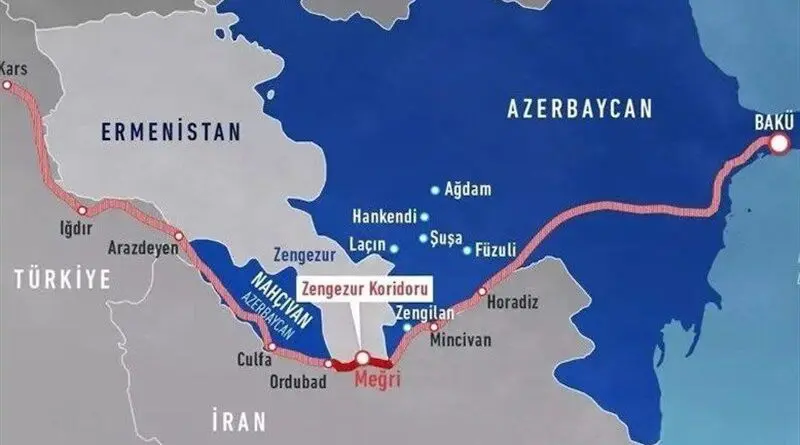
The status of Azerbaijan's non-contigous autonomous region, Nakhchivan, one of Soviet leader Joseph Stalin’s most fateful acts of ethnic engineering more than a century ago, is about to change. The parliament of the autonomous republic asked Baku to approve new constitutional language that drops any reference to the Moscow and Kars treaties of 1921, which made Moscow and Ankara guarantors of the status and borders of Nakhchivan (Minval Politika, February 2). The Azerbaijani parliament took this step on February 2 (Azernews, February 2).
That move effectively puts the status and borders of the autonomous region—a place increasingly important as part of the Trump Route for International Peace and Prosperity (TRIPP) (also referred to as the Zangezur Corridor) linking Azerbaijan and the West— exclusively under Baku’s discretion. This constitutional change opens the way for future changes in either. The Turkish government is unlikely to be disturbed by this move because its standing with Azerbaijan has been secured by more recent bilateral treaties (see EDM, January 22, 28). Moscow, however, is likely to oppose this development as another sign of Azerbaijan’s increasingly independent stance and Russia’s loss of leverage in the South Caucasus. This loss makes this move particularly infuriating because it comes on the eve of U.S. Vice President J.D. Vance’s visit to that region (Minval Politika; Azernews, February 2).
The history of Nakhchivan over the last century has been fraught. When the Red Army restored Moscow’s control over the region in July 1920, it first assigned the territory to Armenia but later transferred it to Azerbaijan. To ensure Soviet control of the South Caucasus and to block Türkiye from having an uninterrupted ground path to Azerbaijan and Central Asia, Stalin, as Soviet Russia’s People’s Commissar for Nationality Affairs at that time, drew borders in the region that separated Nakhchivan from Azerbaijan proper with the Armenian Syunik oblast in between.
To make that permanent, the Kremlin arranged for the signing of two treaties between Soviet Russia and Türkiye in 1921, the Treaty of Moscow and the Treaty of Kars, which declared that while Nakhchivan was part of and under the protection of Azerbaijan, Moscow and Ankara were the guarantors of both its status and its borders. After the Soviet Union was formed in 1922, Nakhchivan formally became part of Azerbaijan. This arrangement continued until near the end of Soviet times, when, during the parade of sovereignties, Nakhchivan declared itself an independent republic. In 1991, after the Soviet Union disintegrated, it became part of Azerbaijan, albeit a non-contiguous one.
Even during the Soviet period, many Azerbaijanis dreamed of recovering the Zangezur corridor between Azerbaijan proper and Nakhchivan, much as many Armenians hoped to annex Karabakh, where ethnic Armenians had a majority, to Armenia. Until the conflict between Azerbaijan and Armenia broke out in 1988, however, Azerbaijanis could travel through Armenia to Nakhchivan, and ethnic Armenians in Azerbaijan, including Karabakh, could travel to Armenia because the entire region remained under Soviet control. After the so-called first Karabakh war, that changed. For most of the war, from 1988 to 1994, Armenia controlled Karabakh and neighboring portions of Azerbaijan while Azerbaijan was blocked from using the Zangezur corridor through Armenian territory to reach Nakhchivan and trade with Türkiye and the West.
From 1994 to 2020 Nogorno-Karabakh was effectively independent but with economic, political, and military reliance on Armenia. Recurrent clashes between Armenia and Azerbaijan continued in the region. In 2020, when Azerbaijani forces recaptured most of Karabakh during the six-week Second Nagorno-Karabakh War, the issue of Zangezur, as Azerbaijanis refer to the corridor, heated up again, especially as trade through it became more important to more parties, including the People’s Republic of China (PRC) and the European Union (see EDM, October 11, 2023, September 19, 2024).
The international system has understandable apprehension about any changes to state borders, and Russia and Iran have specific opposition to shifts in the South Caucasus (see EDM, July 29, 2025). Almost all governments have opposed any change in the political status of the corridor between Azerbaijan proper and Nakchivan, rejecting the possibility of a swap earlier and, more recently, proposing alternatives, including a route through Iran. Despite that history, however, many observers remain convinced that neither Baku nor Ankara will ever give up hopes of putting the Zangezur corridor under full Azerbaijani control (Window on Eurasia, January 15, 2024).
Speculation about that has only intensified since the August 2025 meeting between Baku and Yerevan in Washington. On the one hand, many in the West viewed the steps toward peace between Armenia and Azerbaijan accomplished at the summit and the plans for a U.S.-regulated transportation route (the TRIPP) between Azerbaijan and Nakhchivan as a solution (see EDM, September 8, 2025).
On the other hand, some in Moscow and Tehran saw it not only as a threat to north–south trade but to their influence in the region, given the expanded U.S. role. Some viewed it simply as another move toward the establishment of Azerbaijani control over that route and ultimately of Azerbaijani sovereignty (Window on Eurasia, September 24, 2024, August 12, 2025; see EDM, January 22). The history of the region, especially the developments of the last year, provides context for understanding these moves, as do the constitutional changes in Nakhchivan.
The effects of these changes are certain to be greatest in Azerbaijan. Baku has not formally denounced the 1921 accords, however, and the Azerbaijani government could back away from its latest move if circumstances require. In the short term, however, this action will certainly be read as a declaration by Baku that it will continue to pursue an ever more independent international role, one that rejects Russian efforts to control its policies and others’ efforts to dominate it. That, in effect, returns Baku to the position it sought during the First Azerbaijani Republic after the Russian Revolution, when it sought to be an independent regional actor of the first rank. Over the longer term, what has just happened opens the way for Baku to suppress Nakhchivan’s autonomy, reduce it to the status of the other regions of the country, and even seek changes to its borders and, by extension, to Azerbaijan’s borders as a whole. Many in Azerbaijan could see this as a commitment to eventually making Azerbaijan whole (Window on Eurasia, January 15, 2024).
Other international players will also be affected. Russia will certainly play up that threat, not only to try to force Baku to back down but also to undermine the increasing cooperation of the Armenian government with Azerbaijan. Moscow could also take broader steps to seek to replace the current government in Yerevan lest Armenia moves to cooperate closely with Azerbaijan as it is now doing, and even seek to close the Russian base in Gyumri. The current Iranian government will also likely continue to do what it can to torpedo U.S. involvement in the corridor between Azerbaijan and Nakhchivan (see EDM, July 29, 2025). Nakhchivan’s latest moves with Baku’s support—actions that might appear to some as a kind of diplomatic house cleaning—seem certain to have a major effect on the geopolitics of the South Caucasus now and in the future.
Ardabil Woman Activist Sentenced to Prison and Flogging
Police post attacked in Sistan and Baluchistan; one killed
Nine more prisoners executed in three Iranian cities
UAE: We reject Iran’s continued occupation of the three islands
Iran ranks highest for racial prejudice among 24 countries, study finds
Social media activist arrested in Qazvin
79 prisoners executed in 24 Iranian prisons
Iranian expert warns of risks to flights over Azerbaijan
Six more teachers arrested in Iran
Iranian police shoot dead 9-year-old boy
Armed Clash Reported in Sistan and Baluchistan, One Killed
Death Sentence for Azerbaijani Activist Confirmed
Another Political Prisoner Sentenced to Death in Iran
35 More Students Suspended from University in Iran
Increase in Afghan Fighters Reported in Sistan and Baluchistan
AP: IRGC Forces Helped Houthis Seize Yemen’s Red Sea Coast
Trump shares Hikmet Hajiyev interview, says deal with Iran is possible
Trump: Iran could eventually lose the opportunity to “survive as a nation.”
Iranian airlines' flights to Azerbaijan suspended from today
Pezeshkian faces criticism over UN trip
Death Sentence for Azerbaijani Activist Confirmed
80 Countries Call for Restoration of Shipping Through Strait of Hormuz
Two More Prisoners Executed in Ahvaz and Isfahan
Armed Clash Reported in Sistan and Baluchistan, One Killed
Another Political Prisoner Sentenced to Death in Iran
Iranian police shoot dead 9-year-old boy
Iran Will Not Make Nuclear Concessions, Iranian Official Says
UAE: We reject Iran’s continued occupation of the three islands
79 prisoners executed in 24 Iranian prisons
Qashqai Woman Activist Arrested in Iran
Iranian expert warns of risks to flights over Azerbaijan
Six more teachers arrested in Iran
Iran ranks highest for racial prejudice among 24 countries, study finds
Five Iranian servicemen died in Iraq
Social media activist arrested in Qazvin
Tabriz municipal drivers stage protest
Nine more prisoners executed in three Iranian cities
Historic bridge in Ardabil left neglected