Geopolitical Monitor:
Azerbaijanis are Iran’s largest national minority, with population estimates ranging from 20 to 30 million, concentrated in the northwestern provinces of West Azerbaijan, East Azerbaijan, Ardabil, and Zanjan. The term South Azerbaijan is used by Azerbaijani political organizations as a designation for this community and territory. In northern Syria, the period between the Assad government’s effective withdrawal from Kurdish majority areas in 2012 and the formal establishment of Autonomous Administration of North and East Syria (AANES) administrative institutions in 2018 was approximately six years. However, the foundational administrative and military structures the People’s Defence Units (YPG) used to govern those areas were built and operational within the first twelve months of that withdrawal. Armed factions with preexisting organizational infrastructure, cross border logistical networks, and external political sponsorship were positioned to move when the opening occurred. The degradation of IRGC authority in West Azerbaijan Province is producing a comparable opening.
The Kurdish Coalition and the Syrian Parallel
On 22 February 2026, five major Iranian Kurdish parties formally established the Coalition of Political Forces of Iranian Kurdistan (CPFIK). The founding members, the Democratic Party of Iranian Kurdistan (PDKI), the Kurdistan Freedom Party (PAK), the Kurdistan Free Life Party (PJAK), the Organization of Iranian Kurdistan Struggle (Khabat), and the Komala of the Toilers of Kurdistan represent the broadest unified Kurdish political and military front ever assembled against the Islamic Republic. The coalition’s formation follows decades of systematic suppression of Kurdish cultural, linguistic, and political rights by the Islamic Republic, under which Kurdish political parties have been banned, Kurdish language education prohibited, and Kurdish activists executed or imprisoned at rates comparable to the repression documented against other minority communities in Iran.
Within days of their formation, coalition representatives stated that their forces were “deep inside Iran” and along the Iran-Iraq border, coordinating political and military decisions for what they described as a “new phase.” The coalition’s internal coherence, however, remains to be tested. Its members span a wide ideological spectrum, from the social-democratic PDKI to the PKK affiliated PJAK, and their unified command structure has no operational precedent.
The coalition’s stated objectives include the liberation of “Eastern Kurdistan” and the establishment of a democratic administrative system under Kurdish governance. The coalition’s stated geographic scope includes areas of West Azerbaijan Province where Kurdish and Azerbaijani population zones overlap and have historically coexisted alongside one another. This territory is also the only viable land corridor connecting the Azerbaijani northwest of Iran to Turkey. PJAK, the coalition’s most militarily active member and the Iranian affiliate of the PKK, already has an established operational presence in the Qandil Mountains along the rugged border of West Azerbaijan. Its armed wing, the Eastern Kurdistan Units (YRK), has conducted intermittent engagements in the Piranshahr, Oshnavieh, and Sardasht areas. These towns sit at the precise geographic seam between Kurdish majority and Azerbaijani majority population zones.
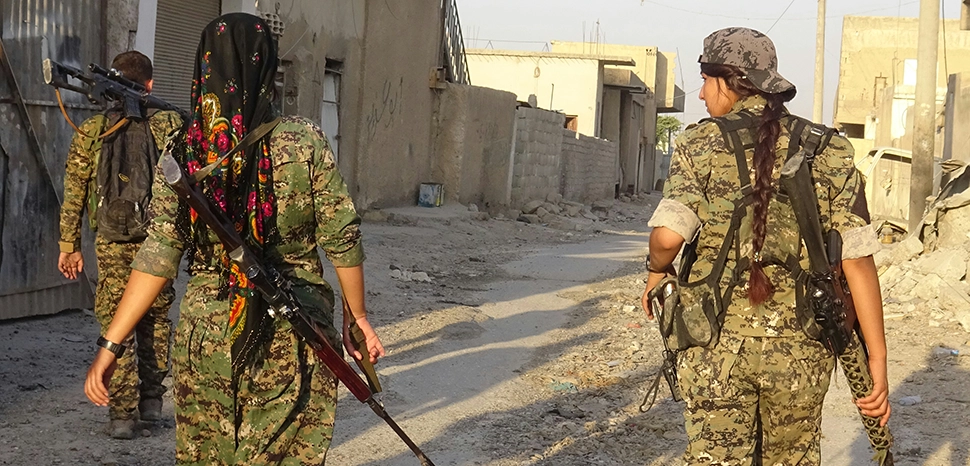
The northern Syria precedent offers a possible template. When the Assad state collapsed in the northwest, the YPG did not wait for a census. It moved. Afrin, Kobani, and ultimately the AANES were facts on the ground before any negotiating table existed. Demographic composition proved insufficient to prevent territorial consolidation by armed actors. Military presence and external political sponsorship was everything.
The structural conditions in northwest Iran today are analogous. The IRGC in the region is being systematically degraded by external strikes. Kurdish parties, uniquely among Iran’s opposition forces, have battle-tested armed formations, cross-border logistical infrastructure based in Iraqi Kurdistan, and, since March 2026, apparent signals of US political interest in their role, reflecting Washington’s assessment of Kurdish armed groups as among the most organized opposition forces capable of operating inside Iran.
South Azerbaijan’s Structural Vulnerability
To understand why these stakes are existential for South Azerbaijan specifically, the history of what happened in Sulduz cannot be set aside. Sulduz, today administratively renamed Naqadeh by Tehran, is a majority Azerbaijani city in West Azerbaijan Province, southwest of Lake Urmia. In April 1979, weeks after the Iranian Revolution, the collapse of central state authority created a political vacuum in the mixed Azerbaijani-Kurdish borderlands. Kurdish political movements began openly asserting demands for regional autonomy. In the town of Sulduz, this power contest turned lethal. Azerbaijani and Kurdish communities clashed in some of the most intense interethnic violence seen in Iran since the revolution. Estimates of casualties range from 100 to 300 killed in the immediate clashes alone, with total casualties across West Azerbaijan Province reaching approximately 1,000 by late April as fighting spread through the region. The violence was devastating for both communities, with Kurdish civilians also suffering significant casualties in the wider West Azerbaijan clashes of that period. The violence exposed a vulnerability that South Azerbaijani communities are a majority in their own territory, but unarmed.
South Azerbaijan’s political movement is, by constitution and by necessity, an unarmed one. Many organizations and political parties have explicitly committed to nonviolent methods as the basis for their political program. Their demands of cultural and linguistic rights, political and economic autonomy, and self determination have been pursued through civil organizing.
Tehran has consistently treated nonviolent South Azerbaijani political organizing as a security threat. Activists have been charged with “enmity against God,” propaganda against the state, and collusion to undermine national security for organizing language rights campaigns. In the 2006 protests that swept Tabriz, Urmia, Ardabil, Maragha, Zanjan, and Sulduz in response to a dehumanizing cartoon published in Iran state newspaper depicting Azerbaijanis as cockroaches, at least 20 to 40 Azerbaijanis were killed and approximately 11,000 were arrested across northwest of the country. The government officially acknowledged only 4 deaths.
The most recent protests in late December 2025, as economic collapse triggered nationwide unrest, followed a similar arc. Azerbaijani participation was initially restrained, analysts noting that this reflected not passivity but the accumulated weight of previous repression and bitter historical memory. In later stages, Tabriz, Urmia, Ardabil, and Zanjan did join the protests. However, the fundamental organizational asymmetry remained: a large, politically aware population with grievances spanning decades, facing a security state with no hesitation about using lethal force, and with no armed capacity of its own to deter that force.
This organizational vulnerability is the specific context in which the Kurdish corridor question becomes consequential for Azerbaijanis in Iran. South Azerbaijan approaches the territorial claims in West Azerbaijan Province from a position of demonstrated internal vulnerability. This community has been killed during interethnic conflict, killed during its own protests, and stripped of the political organizational infrastructure that might otherwise allow it to negotiate rather than absorb outcomes. Kurdish communities in the West Azerbaijan Province have also faced exclusion and their political interests have gone unrepresented in much of post-Islamic Republic planning.
The Geography of the Stakes
There is also the question of Maku where PJAK has begun asserting operational presence in the region since 2006. This Azerbaijani city is positioned as the tripoint of Iran, Turkey, and the Republic of Azerbaijan. Any territorial claims and reorganizations placing Maku within a Kurdish governed zone would directly sever the geographic chain connecting South Azerbaijani population centers to their northwestern anchor and to Turkey’s border. The argument here is about the specific geographic and military logic of a corridor that, if consolidated along the lines of the Syrian model, would be built on military presence rather than negotiated consent from all communities in the affected territory.
This corridor mathematics became kinetic on 5 March 2026 when Iranian drones struck the passenger terminal of Nakhchivan International Airport and a school near the village of Shakarabad. The strike was widely read as Tehran’s message that it retains the capacity and the will to punish Baku for its strategic positioning as Baku is in alliance with Israel and Turkey and implicit alignment with forces seeking to reshape Iran’s northwest. What the Nakhchivan strike clarified is that Baku’s connectivity ambitions and South Azerbaijan’s territorial situation are, in Tehran’s calculation, already part of the same threat matrix.
For Baku, the strategic value of the Maku-Sulduz corridor might be inseparable from the Zangezur question. A future land link between Nakhchivan and Turkey runs through or adjacent to the same territory which Kurdish parties are asserting administrative claims. The Republic of Azerbaijan has a direct state interest in who governs West Azerbaijan Province in any post Islamic Republic transition.
Turkey’s role cannot be separated from this analysis. Ankara has a long standing, active military posture against PKK affiliated forces along its eastern and southern frontiers. The CPFIK coalition includes PJAK which is designated as a terrorist organization by Turkey and the US Department of the Treasury. Any Kurdish corridor consolidating along the Iranian side of the Turkish border, particularly toward the Bazargan border crossing which connects Iran to Turkey through Maku would be read in Ankara as a direct security threat.
Turkey, the Republic of Azerbaijan, and South Azerbaijani political movements therefore share a convergent interest in preventing armed Kurdish territorial consolidation in West Azerbaijan Province. A potential Sinjar to Maku corridor would structurally undermine each of their core security and connectivity objectives simultaneously while eroding a potential Baku-Tebriz-Ankara coalition.
West Azerbaijan Province does not have a homogeneous population in the areas where corridor consolidation is most likely. Azerbaijani majority centers such as Sulduz, Urmia and Maku sit adjacent to Kurdish majority districts in Piranshahr and Oshnavieh. Kurdish communities in these border areas experienced documented village destruction and displacements under Islamic Republic counterinsurgency operations in the 1980s and 1990s, though the full scope remains incompletely documented. In a post-Islamic Republic transition, administrative control over West Azerbaijan Province would involve adjudicating those overlapping claims. No negotiating framework for doing so has been proposed by any of the parties currently operating in the region.
The Organizational Gap and What It Means
The CPFIK has explicitly stated that its administrative structures in “liberated areas” will be governed by a “central alliance management structure” pending democratic elections. This is the same model the YPG used in northern Syria where they establish administrative facts on the ground before any political settlement, and then use this to negotiate from a position of territorial control rather than demographic representation. In comparison, South Azerbaijani movements do not have an equivalent organizational infrastructure in place. They do not have a unified command, a cross-border logistical base, or a formal relationship with the external or internal powers currently shaping events inside Iran.
The Kurdish corridor question is, at its core, a race between organizational capacity and military geography. The CPFIK currently holds a significant organizational advantage and South Azerbaijani movements have not developed a comparable institutional structure. Baku is watching carefully but not yet moving. Ankara is also on the watch. The civilian populations of mixed areas such as Sulduz and Urmia have no clear institutional advocate in the current geopolitical deliberations. The state actors and armed movements shaping the new geography of northwest Iran are making calculations about territory and corridors. The communities who actually live at the seam of those calculations are not at any table where those decisions are being made.
By Turkan Bozkurt
Source: https://www.geopoliticalmonitor.com/the-syrian-clock-is-ticking-in-west-azerbaijan/